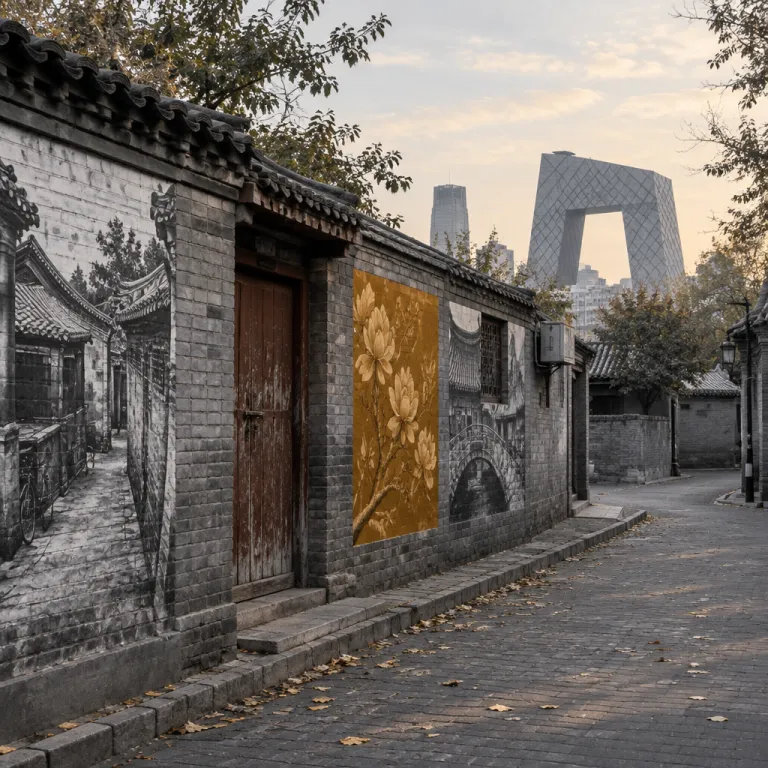
Reading the skyline: architecture as public art in Beijing
Beijing public art murals outdoor installations begin long before you reach any alley wall. The first works on this trail are the large scale buildings that define the city skyline, where architecture becomes sculpture and the line between an art exhibit and engineering quietly dissolves. For luxury travelers choosing a hotel, understanding this relationship between architecture and public art helps you read the city before you ever step into its public spaces.
The CCTV Headquarters by Rem Koolhaas is the clearest example of architecture as public art in contemporary China Beijing. Its looped form hangs over the central business district like a piece of monumental video art frozen in steel and glass, a permanent installation that rivals the best art in any gallery from London to New York City. When you book a room in a premium tower nearby, you are effectively buying a front row seat to one of the world’s most ambitious art projects in the sky.
To the west, the National Centre for the Performing Arts floats beside the old city like a brushed titanium droplet. Locals simply call it “the Egg”, but its curved architecture and shifting color reflections make it feel closer to a museum of contemporary arts than a concert hall. Guests staying near Tiananmen can watch its surface change from silver to rose at dusk, a daily art design performance that rivals installations in Los Angeles or San Francisco yet remains rooted in the specific light and dust of Beijing.
Farther north, the Bird’s Nest stadium still reads as a large scale sculpture rather than a sports venue. Its tangled steel ribs echo the woven pattern of traditional houses in hutong courtyards, turning a mega structure into a subtle homage to the city’s older architecture. For travelers who know public art in the United States, the United Kingdom or Mexico City, this fusion of stadium and sculpture feels familiar yet distinctly China, a reminder that Beijing’s skyline is a curated collection rather than a random accumulation.
Choosing a luxury hotel with views of these landmarks is not just about status. It is about placing yourself inside Beijing public art murals outdoor installations, where every window becomes a private gallery framing the city as a living art exhibit. Properties around the CBD, the Second Ring Road and the Olympic Green effectively function as elevated galleries, offering perspectives on public art that no street level tour can match.
798 and beyond: where galleries meet outdoor installations
Once you have traced the skyline, the next chapter of Beijing public art murals outdoor installations unfolds at ground level in the former factory district of 798. This is where the city’s contemporary art scene first gained international attention, and where the line between gallery interior and public spaces outside has always been porous. For design minded travelers, staying in the northeast of the city places you within easy reach of this constantly evolving open air collection.
Inside 798, galleries present rotating art exhibits that would feel at home in London, Hong Kong or São Paulo, yet the most memorable works often sit in courtyards and along brick walls. Sculptures lean against old factory houses, murals wrap around staircases, and video art flickers in windows that once belonged to military workshops. The entire district functions as a single large scale art project, echoing creative neighborhoods from Shanghai to Mexico City while remaining unmistakably Beijing.
Outside the white cube spaces, you will find public art that feels closer to the street than the salon. Young age artists from across China and the wider Middle East region experiment with color, text and form on warehouse facades, turning loading bays into canvases and alleyways into improvised galleries. Some pieces reference art York or Los Angeles graffiti traditions, while others draw on calligraphy and folk motifs from rural China Beijing, creating a layered visual language that rewards slow walking.
For a deeper dive into how this district evolved from factories to one of the best art destinations in the city, read the guide to Beijing’s art districts for design minded travelers. It explains how 798 became a template for later art projects across the city, including smaller clusters of studios and galleries now appearing in former industrial zones. When you book a luxury hotel in the northeast, you gain not only quick access to these spaces but also a quiet base to process the visual overload that 798 and its neighboring warehouses deliver.
Many high end properties in this part of the city now curate their own art collections, blurring the boundary between hotel and gallery. Lobby installations reference the industrial architecture outside, while suites feature works by Beijing and Shanghai artists who also show in New York and London. Staying here turns your room into a private viewing space, extending the experience of Beijing public art murals outdoor installations long after the district’s cafés close for the night.
Hutong murals off the grid: Yangmeizhu Xiejie and Fangjia 46
The most intimate side of Beijing public art murals outdoor installations hides in the hutongs, where grey brick walls carry quiet conversations in paint. Yangmeizhu Xiejie, once lined with dusty bookshops, now houses independent stores and small designer studios that treat their facades as evolving canvases. Here, color appears in careful doses, with murals that reference the lane’s scholarly past while speaking the visual language of contemporary art.
On Yangmeizhu Xiejie, you might see a mural of stacked books dissolving into abstract forms, or a subtle piece where calligraphic strokes morph into city skylines. These works rarely go viral on social media, yet they offer some of the best art experiences in the city for travelers willing to walk slowly and look closely. Luxury hotels near Qianmen or the central axis make this lane an easy detour between more famous landmarks, turning a simple stroll into a curated art exhibit in public spaces.
Farther north, Fangjia Hutong’s No. 46 Courtyard occupies a converted factory that now hosts a theater, an art gallery and regular cultural pop ups. The courtyard walls carry layers of murals, posters and hand painted signs, creating a living collage that shifts with each new art project. Some pieces nod to art design scenes in New York City or San Francisco, while others reference Hong Kong cinema or youth culture from across the United States and the United Kingdom.
Because these hutong works are not officially monumental, they appear and disappear with little ceremony. An artist might paint over an older piece in June, only for another to arrive by autumn, turning the lane into a constantly refreshed collection. This ephemerality is part of the appeal for solo travelers who prefer unscripted experiences over fixed itineraries, and it pairs well with a flexible stay at a central property like the elegant Wangfujing base for hidden city adventures.
If you want a structured way to connect these quieter murals with the headline architecture, follow a self guided route that links Yangmeizhu Xiejie, Fangjia 46 and the central landmarks. A detailed outline appears in the feature on Beijing experiences worth flying for, which treats public art as a thread running through food stalls, teahouses and design shops. Walking this route, you will feel how Beijing public art murals outdoor installations stitch together the monumental and the everyday, the global and the hyper local.
Planning your stay: hotels that live like galleries
For travelers who care about Beijing public art murals outdoor installations, the hotel is not just a place to sleep. It becomes a base camp for exploring the city’s arts ecosystem, and often a gallery in its own right. Choosing the right property means aligning your stay with the parts of the city where public art, architecture and daily life intersect most vividly.
In the central business district, several luxury towers treat their lobbies as curated galleries, with rotating art exhibits that echo the surrounding skyline. You might check in beneath a large scale installation that references the CCTV tower, then ride an elevator whose interior lighting shifts color like a piece of video art. These properties often collaborate with university art departments and independent curators from Beijing and Shanghai, creating collections that feel as current as anything in Hong Kong or London.
Closer to the historic core, high end courtyard houses and design forward hotels in the hutongs offer a different relationship to public art. Here, the architecture itself becomes part of the experience, with grey brick walls framing glimpses of nearby murals and small sculptures tucked into shared courtyards. Guests wake to the sound of bicycle bells and the sight of a new stencil appearing overnight, a rhythm that feels closer to Mexico City or São Paulo than to the polished districts of Hong Kong.
Many of these properties now commission their own art projects, inviting young age artists from across China and the wider Middle East and United States to create site specific works. A stairwell might host a series of photographs referencing art York and New York City, while a rooftop terrace features a mural that nods to Los Angeles street art and San Francisco color palettes. The result is a layered experience where your hotel stay, the surrounding public spaces and the wider city all feel like parts of a single, evolving art exhibit.
When comparing options, think about how you want to move through the city’s arts landscape. A CBD tower is better for travelers who prioritize skyline architecture and quick access to major galleries, while a hutong property excels at immersing you in smaller scale public art and daily neighborhood life. Either way, treating your hotel as part of Beijing public art murals outdoor installations will sharpen your sense of place and turn even short walks into curated journeys.
A global frame: placing Beijing’s public art in an international context
Beijing public art murals outdoor installations do not exist in isolation. They sit inside a global conversation that stretches from New York to Hong Kong, from Los Angeles to the Middle East, and from São Paulo to the United Kingdom. Understanding this wider frame helps luxury travelers appreciate why the city feels both familiar and utterly singular.
In New York City, public art often clusters around institutions and parks, while in Mexico City it spills across entire neighborhoods with a casual intensity. Beijing takes a different path, weaving public art through monumental state architecture, semi official cultural districts and informal hutong walls. The result is a layered city where an art exhibit might appear on a stadium facade, a factory chimney or the side of a family home, each carrying a different relationship to power, memory and daily life.
Comparisons with Hong Kong and Shanghai are particularly revealing. Hong Kong’s public art leans heavily on waterfront promenades and corporate plazas, while Shanghai often uses riverfront warehouses and polished design districts as its primary stages. Beijing, by contrast, lets its public spaces tell a more fragmented story, with art projects surfacing in subway underpasses, university campuses and residential compounds, then fading or shifting as the city evolves.
For travelers used to the curated clarity of arts districts in London, Los Angeles or San Francisco, this can feel disorienting at first. Yet it is precisely this unevenness that makes Beijing one of the best art cities to walk without a fixed plan, especially when you base yourself in a hotel that sits between formal galleries and older neighborhoods. Over a few days, you will start to see how a mural in a hutong, a sculpture outside a theater and a piece of video art in a hotel lobby all belong to the same conversation.
As you move through this landscape, remember that every city’s public art reflects its own negotiations between history, capital and community. Beijing’s version of this negotiation is written across its architecture, its alleys and its constantly shifting walls, inviting you to read the city as a living collection rather than a static museum. Approach it that way, and your luxury stay becomes less about ticking off landmarks and more about joining an ongoing, open air art project that stretches from the CCTV tower to the hutong murals nobody posts.
FAQ
Where should I stay in Beijing to be close to public art and murals ?
For easy access to Beijing public art murals outdoor installations, choose a hotel in the central business district or near the historic core around Wangfujing and Qianmen. The CBD places you near major architectural landmarks and several contemporary galleries, while central properties near the old city walls give quick access to hutong murals on streets like Yangmeizhu Xiejie and Fangjia Hutong. Both areas offer luxury and premium options that work well as bases for self guided art walks.
Can I explore Beijing’s public art trail on my own, or do I need a guide ?
You can comfortably explore most public art, murals and outdoor installations on your own. Major architectural works such as the CCTV tower, the National Centre for the Performing Arts and the Bird’s Nest are easy to reach by taxi or subway, and hutong areas like Yangmeizhu Xiejie are walkable from many central hotels. A private guide can add context, but independent travelers with a good map and comfortable shoes will see plenty.
Are the hutong murals permanent, or do they change often ?
Hutong murals are usually temporary and change regularly. Walls in lanes such as Yangmeizhu Xiejie and around Fangjia 46 often host new pieces, posters or painted signs every few months, especially when cultural events or small festivals take place. This constant renewal means each visit offers a different collection of works, even if you walk the same route.
How much time should I plan for Beijing’s public art and design districts ?
Plan at least one full day for 798 and nearby warehouses, plus another day for a combined route linking central landmarks with hutong murals. If you are staying three or four nights, you can comfortably balance these art focused walks with visits to major cultural sites and relaxed time in your hotel. Longer stays allow you to revisit favorite neighborhoods at different times of day, which often reveals new details in the public art.
Is Beijing’s public art scene suitable for solo travelers interested in design ?
Beijing is particularly rewarding for solo travelers who care about art and design. The main districts and hutongs mentioned here are busy, central and generally straightforward to navigate, with plenty of cafés and small restaurants where you can pause between walks. Staying in a design focused luxury hotel adds another layer, turning your base into a quiet gallery where you can reflect on what you have seen in the city’s public spaces.